
How to Split Your Supermarket Shop and Save Money
Buying different items from different supermarkets can reduce your grocery bill, but the saving needs to outweigh extra travel or delivery costs. Shopsplit compares your shopping list across one, two or more stores so you can choose a split that works for your budget and routine.
Why one supermarket is costing you more than you think
Most people pick one supermarket and stick to it. It’s convenient. But convenience has a price.
Aldi and Lidl consistently undercut the big four on own-brand staples — pasta, rice, eggs, dairy — by 20–40%. Meanwhile, Tesco or Sainsbury’s might be running a Clubcard or Nectar promotion that makes certain branded products cheaper there this week. Asda might have the best price on something else entirely.
When you shop at one store for everything, you’re overpaying on a large chunk of your basket. Every single week.
UK households that actively compare prices and split their shop save an average of £500–£600 per year compared to those who shop loyally at one chain.
What split shopping actually means
Split shopping means deliberately buying different items from different stores to get the best price on each. Instead of doing one shop at Tesco, you might buy your branded items at Tesco and your staples at Aldi.
The concept is simple. The problem is working out what to buy where — that’s where it gets tedious if you try to do it manually.
The problem with doing it yourself
To split your shop properly by hand, you’d need to:
Build your list
Write out every item you need this week
Check every price
Look up each item at every supermarket, including loyalty card prices and current promotions
Do the maths
Work out whether delivery fees from a second order still leave you better off
Make the call
Decide what to buy where — and remember all of it when you actually shop
Nobody does this. It takes too long. Which is exactly why most people don’t split their shop — not because it’s a bad idea, but because the legwork is exhausting.
How Shopsplit does it for you — in seconds
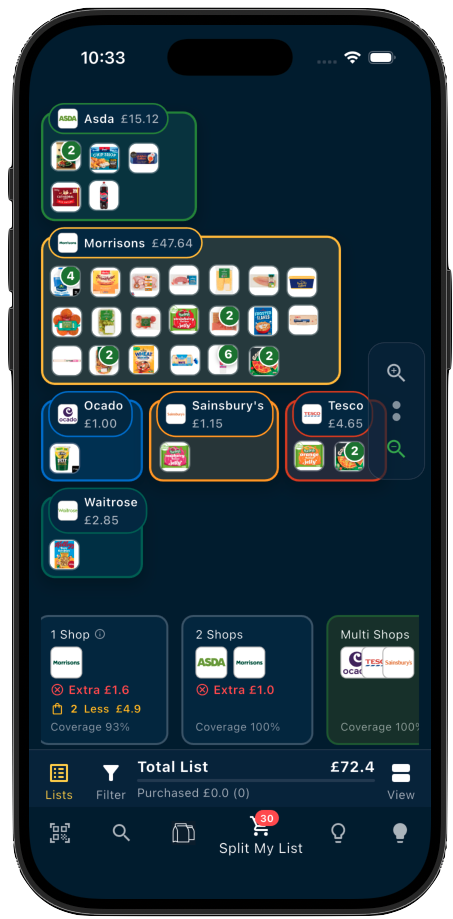
Shopsplit was built specifically to remove that legwork. You build your shopping list once — or import an existing online order — and Shopsplit analyses every item across the major UK supermarkets simultaneously.
It then tells you:
- Which items are cheapest at which store
- Whether splitting across two or more stores actually saves you money
- Which products have cheaper alternatives you might not have considered
- Your total cost at each combination of stores
The whole analysis takes seconds. You get a clear recommendation — shop here for these, shop there for those. No spreadsheets, no tab-switching, no guesswork.
Shopsplit covers 220,000+ products across Tesco, Sainsbury’s, Asda, Morrisons, Aldi, Ocado, Waitrose and Co-op.
How many supermarkets is worth it?
More shops means more savings — but with diminishing returns. Based on typical UK shopping lists:
For most households, splitting across two supermarkets hits the sweet spot — meaningful savings without adding much complexity to your week. A third store can close most of the remaining gap if you want to go further, but beyond that the returns are marginal.
Shopsplit will tell you when a split is genuinely worth recommending. If the potential saving is small relative to your list, a single-store shop may be the better call — and Shopsplit will say so.
What about substitutes?
Alongside the split recommendation, Shopsplit highlights product substitutes — items available at other supermarkets that are comparable to what you currently buy, but at a lower price.
In many cases, substitutes deliver more savings than store-switching alone. Buying the same branded product at a different supermarket might save you 10–15p. Switching to a comparable alternative — same quality, different label — can save £1 or more on a single item.
That said, substitutes are personal. Some shoppers are happy to swap most products for a cheaper alternative. Others have strong preferences on specific items — a particular brand of coffee, a specific type of bread — and won’t budge. Both are completely valid.
Shopsplit is designed to respect this. The app aims to learn your preferences over time, so substitute suggestions get smarter the more you use it — surfacing swaps you’re likely to accept and filtering out ones you’ve rejected before.
One question people often ask: is a Tesco own-brand product the same as a Waitrose own-brand? Not necessarily — private label products differ in recipe, sourcing, and quality across retailers. Shopsplit treats them as distinct products rather than direct equivalents, so you always know exactly what you’re being compared against.
How Shopsplit helps you act on the savings
Finding the savings is only half the job. Shopsplit also helps you carry them through when you actually shop.
Once you have your split recommendation, your shopping list stays live in the app — organised by store, so you always know what to pick up where. As you shop, you can tick items off directly in the app, keeping track of what’s done and what’s left.
If you’re shopping with someone else, or want to send a list ahead, you can share or email your list from the app — useful for splitting the shop between two people across two stores at the same time.
The goal is to make the savings as easy to realise as possible — not just identify them on a screen and leave the rest to you.
Related guides
Ready to split your next shop?


About Us
App Features
Newsletter
Resources
Savings Example
Supermarkets
Online Grocery Orders
Split Your List and Save
Cheapest Supermarket Index
Support
Contact Us
Video Tutorials
© 2026 Shopsplit Ltd. All Rights Reserved. Privacy Policy
71-75 Shelton Street, Covent Garden, London, WC2H 9JQ, UK 🇬🇧